Voters are not fooled by the clowns they elect. They are passing a verdict on the palace that failed them.
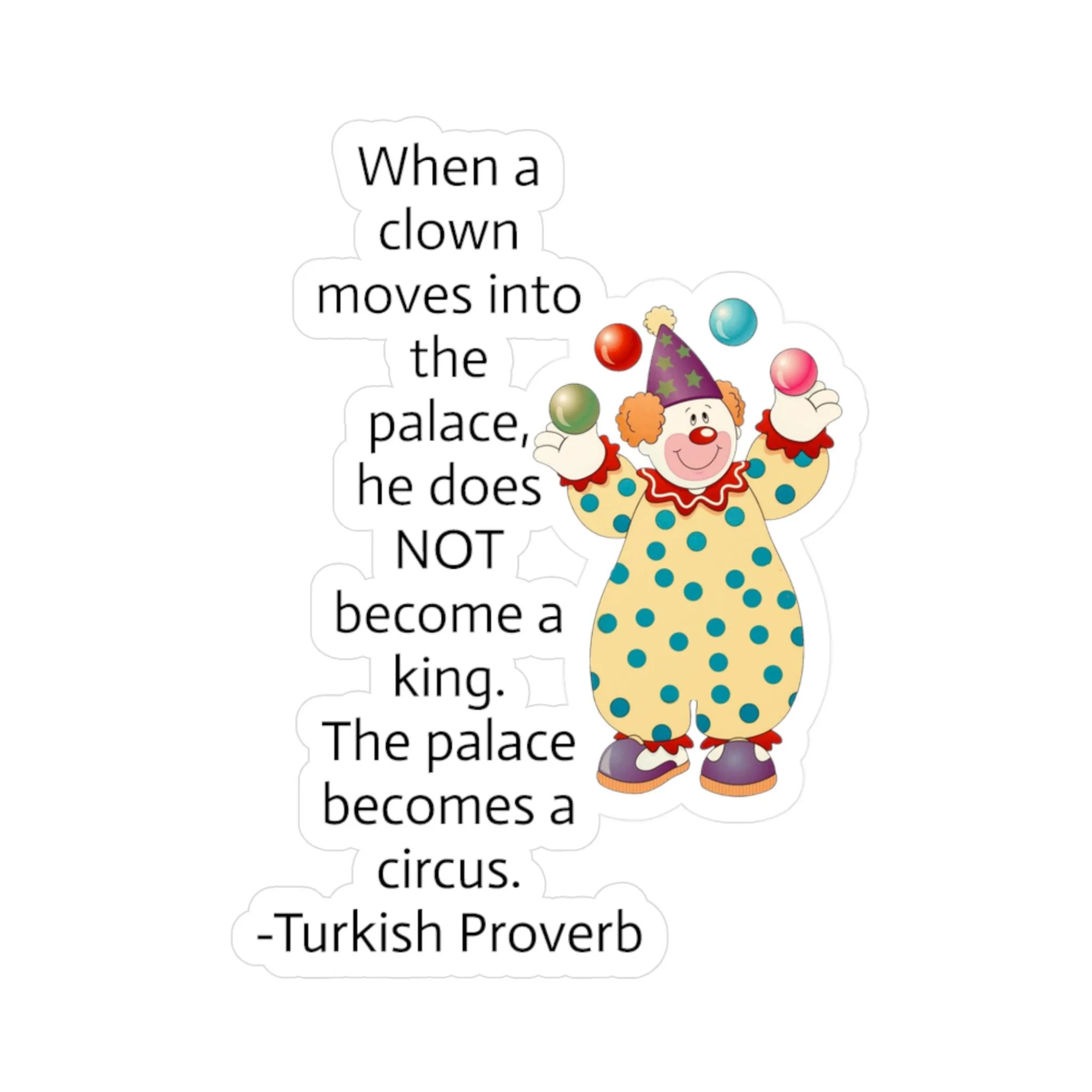
There is a line that travels the internet as a Turkish proverb: when a clown moves into a palace, he does not become a king; the palace becomes a circus.
It is usually quoted as a lament. Read it slowly and it becomes a diagnosis. The palace was already a stage. The clown simply stopped pretending it wasn't.
Over the last fifteen years the pattern has turned up everywhere, in every ideological colour. A television comedian became mayor of Reykjavík on a joke ticket. Another became president of Guatemala. A third became president of Ukraine after playing one on TV. Career politicians learned the act too: the tousled hair, the chainsaw on stage, the gaffe that breaks the news cycle.
The clown is not a party. The clown is a method. And the question worth asking is not how could voters be so foolish, but what question was the palace no longer answering?
Four masks of the fool
The clown is not one figure but four. Each explains a different part of the vote.
The jester. The only man licensed to mock the king to his face. Today he is the outsider who "says what everyone is thinking."
The carnival. One day a year the beggar was crowned and the bishop was mocked, then order returned. Today the election itself becomes the ritual of inversion: put the low on top, humiliate the high.
The circus. Spectacle handed to the crowd in place of bread. Today governance becomes content: the feud, the stunt, the clip.
The trickster. The mythic rule-breaker who sometimes remakes the world. Today the rule-breaking is the programme.
India knows this figure well. Birbal in Akbar's court and Tenali Raman in Krishnadevaraya's were wits, not fools. Their jokes punctured royal vanity and exposed corrupt courtiers, and the emperors kept them close precisely because they would.
But they stood beside the throne, never on it. The jester was a corrective, not a replacement. Carnival lasted a day, then Lent arrived. Let the fool speak truth, the old design said, but do not hand him the treasury.
Somewhere along the way, the crowd stopped wanting the jester to advise the king. It wanted the jester to be the king.
The palace lost its licence
The establishment's oldest pitch was simple: we are dull, but we are competent. That bargain holds only while the dull work keeps working.
Consider what two decades delivered to an ordinary voter. A war sold on intelligence that proved wrong. A financial crash built by the most credentialed people on earth, then bailouts for them and austerity for everyone else. Pandemic guidance that shifted without much explanation. Then a cost-of-living squeeze first waved away as transitory.
The numbers now read like a medical chart. Edelman's 2026 survey of nearly 34,000 people across 28 countries traces a slide from fear, to polarisation, to grievance, and now to insularity (Edelman). Last year about six in ten said business and government had harmed them and that the system favours the rich. This year 70 per cent are wary of trusting anyone with different values or sources, and only a third say most people can be trusted (Richard Edelman).
The same report finds a 15-point trust gap between high and low earners worldwide. Just 15 per cent in developed markets expect the next generation to do better, and India is among the Asian economies where that hope fell by double digits in a year.
If the competent cannot be trusted to deliver competence, competence stops being the thing worth voting for.
So the voter shops for something else: loyalty, emotion, revenge, the feeling of being seen. The clown sells all four.
The honest liar
The strangest part of the analogy is the make-up. A clown's face is the most artificial face in the room, yet it is the one we trust not to be hiding anything.
That is because the clown's mask announces itself. The career politician wears one too, the media-trained smile and the focus-grouped sentence, but insists it is his real face. Offered two performers, voters prefer the one who admits he is performing. The gaffe proves nobody wrote the script.
This is more than a hunch. In 2018, sociologists Oliver Hahl, Minjae Kim and Ezra Zuckerman Sivan tested a puzzle: how can voters find a candidate authentic while knowing he lies? Their experiments suggested that when a candidate tells an obvious untruth as part of a broader attack on establishment norms, aggrieved listeners hear a deeper message, that the establishment itself is illegitimate (American Sociological Review).
Two findings stand out. The effect did not depend on information access, culture or gender; it was enough that one side of a social divide saw the system as rigged. And it worked on voters of both major parties, whenever the candidate seemed to channel their grievances (Newswise).
Condemnation from above is not a cost to the clown. It is his credential.
Every fact-check and every elite expression of horror tells his audience exactly what it wanted to hear: the people you resent hate him.
Life under the big top
The clown did not invade politics. Politics moved into the circus tent, and the clown was the act best suited to the venue.
The Roman satirist Juvenal complained that his people had traded political power for bread and games. In 1967 Guy Debord described modern life as a spectacle, where images of things replace the things themselves. In 1985 Neil Postman warned that democracies would not be crushed by an Orwellian boot but entertained into helplessness, as television turned every public question into a show.
Postman never saw the feed. An algorithm does not reward the truest statement; it rewards the one that stops your thumb. Outrage stops it. Mockery stops it. A chainsaw held aloft on stage stops it. A forty-page paper on fiscal consolidation does not.
Anyone who watches prime-time television knows the format: split screens, shouting panellists, a ticker in red capitals. It is a circus ring with a broadcast licence. Anchors who once questioned clowns now compete with them for the same attention, and many have quietly become clowns themselves.
In a tent built for spectacle, the dull competent candidate is not merely less exciting. He is structurally invisible. Voters cannot choose what they never see.
The last laugh
For many voters, choosing the clown is not a mistake. It is a joke they are telling, and the punchline is the elite.
The Russian thinker Mikhail Bakhtin called this carnival laughter. It is not the polite chuckle of the drawing room. It drags the high down to the level of the market and the street. At carnival the fool wore the crown precisely because it insulted the crown.
Iceland offers the purest case. After its banks collapsed in 2008, the comedian Jón Gnarr launched a self-declared joke party, promised absurdities such as a polar bear for the city zoo, and in 2010 became mayor of Reykjavík. His voters were not confused. They were telling the bankers and politicians who wrecked the country: we would rather be governed by a joke than by you.
There is a quieter motive too. Many people have spent years being laughed at: their accents mocked, their jobs dismissed, their worries called backward. The clown flips that. Now they are in on the joke, and those who sneered are the punchline.
In an insular age, that belonging matters. When only a third of people trust strangers, the in-joke becomes a tribal password. Laughing at the clown's jab tells everyone which side of the tent you sit on.
The case for the clown
An unfiltered essay owes the other side a hearing, and the other side has real arguments.
"Clown" is often just an insult. Lincoln was caricatured as a backwoods buffoon; Reagan was dismissed as a B-movie actor. Calling a leader a clown can be the very condescension that drove voters to him. If this essay sneers at voters, it repeats the palace's mistake.
Some clowns turn out to be serious. Volodymyr Zelensky was a sitcom star; when war came he stayed in Kyiv and became one of the defining wartime leaders of his era. Jón Gnarr's joke party ran Reykjavík in coalition for four broadly functional years. The costume said nothing about the competence underneath.
Outsiders can break cartels. A political class that recycles the same families and donors may need someone rude enough to kick the door in. Not every norm the clown breaks deserved protecting.
On outcomes, though, the evidence cuts the other way. Economists Manuel Funke, Moritz Schularick and Christoph Trebesch studied 51 populist presidents and prime ministers, the category closest to our clown, from 1900 to 2020. Fifteen years in, GDP per capita was about 10 per cent below comparable countries, alongside weaker institutions; the pattern held for populists of left and right (American Economic Review). Many had taken power right after an economic crisis, which fits the story of a palace that failed first.
Yet such leaders tend to stay in office roughly twice as long as non-populists (Review of Democracy). Voters are not judging the clown on the technocrat's ledger. That is the whole point.
Who sold the tickets?
The proverb got the order wrong. The clown did not turn the palace into a circus. The palace sold the tickets, raised the tent, and then complained about the act.
People choose clowns for reasons that hang together. The competent stopped delivering competence. The obvious liar seemed more honest than the polished one. The feed rewards spectacle over substance. And laughing at the powerful feels like the only justice on offer. None of this requires the voter to be stupid. All of it requires the establishment to have failed first.
The old courts understood something we forgot. They kept the fool close, licensed him to mock, and let carnival run its day so that it would end. A free press, sharp satire and an honest opposition are the modern jester's licence. Silence them, or let them decay into noise, and the crowd stops wanting a jester beside the throne and starts wanting one on it.
The cure is not to sneer at voters, and it is not to ban the clown. It is for the palace to earn back the right to be boring, by actually working, and for the press to stop selling seats in the tent. Until then, the circus will not leave town. It will simply renew its lease.
POLITICS
Send in the Clowns: Why Democracies Keep Crowning the Jester
The clown in the palace
Rate this article
5.0 / 5 · 1 rating
No reviews yet. Be the first to respond.