The economic tsunami now washing over ordinary households did not come without warning. Governments saw it coming, had the data, and chose other priorities.
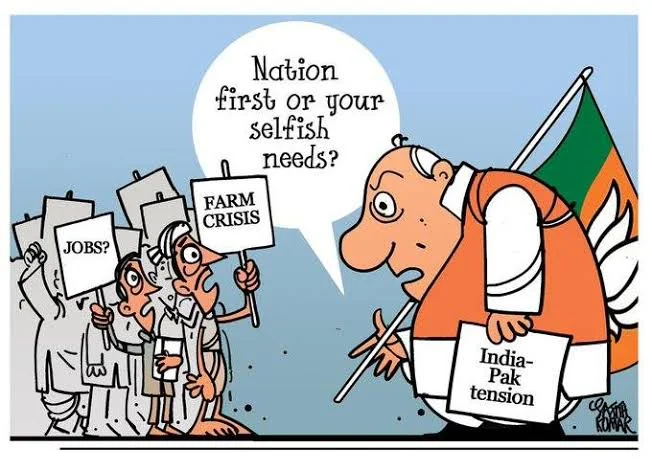
Ask anyone at a petrol pump, a ration shop or a job fair what they think of their government's economic management, and you will hear the same answer in a dozen languages. Prices are up. Wages are not. The jobs young people trained for are disappearing. And from the podiums of power come speeches about strength, growth and destiny.
This is not a natural disaster. A tsunami gives you minutes of warning. This one gave years. The institutions that governments fund, the IMF, the ILO and their own central banks, spelled out the risks in plain language. The response from too many capitals has been the same: spend on weapons, tax the fuel, borrow for today and leave the bill for tomorrow.
This piece sets out the charge sheet, the evidence, and what citizens are entitled to demand.
The warnings were on the tableb
No finance minister can claim surprise. The numbers have been public for months.
Warning
Who said it
What governments did with it
Global growth slowing to 3.1% in 2026, inflation rising to 4.7% on food and energy
IMF, World Economic Outlook, Oct 2026
Revised forecasts, issued statements
Economies' capacity to absorb new shocks is shrinking
IMF, Oct 2026
Kept spending as if it were not
Countries must rebuild fiscal space "without further delay"
IMF, Oct 2026
Delayed
Youth unemployment rose to 12.4% in 2025; 257 million young people not in work, education or training
ILO, Aug 2026
Launched schemes; the numbers kept rising
Entry-level clerical, sales and admin jobs are shrinking as AI spreads
ILO, Aug 2026
Celebrated AI investment, funded little retraining
The IMF's own advice was blunt: support for households hit by higher food and energy prices should be temporary and targeted, and governments must fix their finances now. In other words, protect the vulnerable and stop wasting money. Most governments managed neither.
Failure one: an energy policy built on hope
For fifty years, every oil shock has delivered the same lesson: a country that imports its fuel imports its crises. Governments listened, nodded, and kept importing.
When shipping through the Strait of Hormuz seized up this year, Brent crude jumped from about $67 a barrel in January to over $100 by October. Between late February and mid-May, petrol rose about 45% in the United States, 55% in Pakistan and 52% in the UAE. Citizens of rich and poor countries alike discovered that their leaders had no plan beyond waiting for the war to end.
India did better on the surface. Excise cuts and state-owned oil companies holding prices kept the rise to about 4% over the same period. But look at how that was paid for. Oil marketing companies were absorbing losses of nearly ₹1,000 crore a day, and the excise cut carved a hole in public revenue. That is not protection. It is a bill deferred to the same taxpayers, with interest. And it does nothing about the core weakness: India still imports more than 85% of its crude.
Solar, storage, hydropower, public transport and strategic reserves have been promised in speech after speech. Had they been built at the speed they were announced, the Hormuz crisis would have been a headache. Instead it is a household emergency.
Failure two: guns before bread
While families cut back on food and fuel, governments found money for one thing without hesitation: their militaries.
According to SIPRI, world military spending reached a record $2,887 billion in 2025. It was the 11th straight year of increases, pushing the global military burden to 2.5% of GDP, the highest since 2009. Europe raised spending 14%; Asia and Oceania 8.1%, their fastest rise since 2009. India, the world's fifth-largest spender, increased its budget 8.9% to $92.1 billion. SIPRI expects the growth to continue through 2026 and beyond.
That works out to roughly $350 for every person on the planet, spent in a single year on armies, while the ILO counts 257 million young people with no job, no training and no school.
Security matters. No serious person argues that a country should leave its borders undefended. But when every capital is arming against every other, and the ensuing wars drive up the price of the oil every family needs, the arms race stops being defence. It becomes a tax on the poor, collected through the petrol pump and the grocery bill.
Failure three: a generation told to wait
Young people were promised that education would open doors. Governments have quietly let those doors close.
The ILO reports that global youth unemployment rose to 12.4% in 2025: 67 million young people out of work. One in five young people worldwide, more than 257 million, is in neither work, education nor training. Youth unemployment rose in eight of the world's eleven subregions between 2023 and 2025, and the ILO now warns of a new youth jobs crisis.
The jobs that used to give young people a first foothold, in clerical, administrative, sales and routine technical work, are the very ones shrinking as automation and AI spread. Governments have spent years celebrating AI investment and announcing digital missions. Far fewer have funded the retraining, apprenticeships and social protection the ILO says are needed to keep young workers from being left behind.
In developing countries the picture is grimmer still. Nearly nine in ten young workers in low and lower-middle income countries work informally, with no contract, no pension and no safety net. When the shock comes, they have nothing to fall back on. That is not bad luck. It is the predictable result of policy that measures success by headline growth instead of decent jobs.
Failure four: the cupboard was empty before the storm
The oldest rule of public finance is to save in good years so you can spend in bad ones. Governments borrowed in good years and are borrowing again now.
The IMF's Fiscal Monitor reports that global public debt rose to just under 94% of GDP in 2025 and is on track to hit 100% by 2029. That would be the highest level since the aftermath of the Second World War. The IMF says this pile-up is driven largely by the world's major economies, under pressure from social needs, defence and rising interest bills, with the Middle East conflict adding further strain. Its verdict: credible fiscal adjustment is "urgently needed across all country groups."
Think about what that means for ordinary people. Every rupee, dollar or euro spent on interest is money not spent on hospitals, schools or a safety net for workers who lose their jobs. When the next shock arrives, a government with no fiscal room has two choices: cut support or print money. Both land on the same citizens.
The tragedy is that this squeeze was a choice. Debt piled up through years of election-season giveaways, untargeted subsidies and prestige projects. When a real emergency finally arrived, the cupboard was already bare.
What governments owe their people now
Criticism is cheap unless it comes with demands. Here is what citizens should insist on, and hold their representatives to:
1. Targeted relief, not blanket subsidies. Direct cash or ration support to the poorest households, as the IMF itself recommends, instead of across-the-board fuel giveaways that mostly benefit the well-off.
2. An energy security plan with dates, not slogans. Published targets for renewables, storage, hydropower, public transport and strategic oil reserves, with progress reported every quarter.
3. A jobs guarantee for the young. Funded apprenticeships, retraining for workers displaced by automation and AI, and employment services that actually place people in work.
4. Honest budgets. Show citizens what is spent on defence, interest, subsidies and welfare, and justify each line. A public that can see the trade-offs can judge them.
5. Diplomacy as economic policy. Every war that disrupts trade raises prices at home. Governments that treat de-escalation as weakness are making their own citizens pay.
6. A safety net that exists before the crisis. Unemployment insurance and portable benefits for informal and gig workers, built now, not announced after the layoffs.
The defence, and why it falls short
An unfiltered paper prints the other side too. Governments and their supporters make several serious arguments.
"This shock came from outside." True. No finance ministry started the conflict around Hormuz. But external shocks are exactly what preparation is for. Resilience is judged by how a country handles the storm it did not cause.
"We did act." Some did. India's excise cuts and price restraint kept its fuel inflation far below that of the US, Pakistan or the UAE in the first months of the crisis, and the IMF says the world economy has proved more resilient than feared, with growth slowing rather than collapsing. Credit is due. But a temporary cushion paid for with lost revenue and oil-company losses is not the same as reducing the vulnerability.
"Defence spending is non-negotiable in a dangerous world." Many voters agree, and threats are real. The question is not whether to defend, but whether ever-rising military budgets are crowding out the energy, skills and social spending that make a country resilient in the first place.
"Debt was needed to get through COVID and now this." Partly fair. Emergencies justify borrowing. The failure lies in the years between emergencies, when buffers should have been rebuilt and were not.
These arguments deserve a hearing. They do not change the verdict: the warnings were clear, the tools were known, and too many governments chose the comfortable path over the prepared one.
Until they act, protect yourselves
Governments will not fix this in time for this month's bills. So while we keep holding them to account, families must look after themselves: build an emergency fund, clear expensive debt, protect your income with new skills, cut fuel use, and ignore anyone selling guaranteed returns. Our companion guide, Riding Out the Economic Storm, sets out the steps in detail.
And remember who works for whom. A government that cannot protect its people from a storm it was warned about owes them more than speeches. It owes them answers. Ask for them, loudly, at every opportunity, and at the ballot box.
The Unfiltered Gazette. We print what they bury.
Opinion. Figures as of late October 2026.
Sources
• IMF projects global economic growth of 3.1% in 2026 — Trend News Agency, 15 Oct 2026 (IMF World Economic Outlook, October 2026)
• Fiscal Policy under Pressure: High Debt, Rising Risks — IMF Fiscal Monitor, April 2026
• Global military spending rise continues as European and Asian expenditures surge — SIPRI, 27 Apr 2026
• Youth unemployment rises as young people face a harder road to decent work — ILO, 11 Aug 2026
• Oil Price Update October 2026 — Oil & Gas Storage News, 4 Oct 2026
• Petrol & Diesel Prices Surge Globally: Why India Saw Only a 4% Rise — Ventura Securities, 20 May 2026
LAW & POLICY
Drowning by Design: How Governments Left Their People to Face the Economic Tsunami Alone
“They spent the warnings on weapons, the surplus on slogans, and the future on interest. Now they want you to tighten your belt.”
Rate this article
— / 5 · 0 ratings
No reviews yet. Be the first to respond.